

Cooperation programme – Iraq
Context
Iraq has a population of approximately 44 million. After years of conflict and large-scale displacement, the number of internally displaced people has fallen from around 6 million at its peak to approximately 1 million, of whom some 97,000 remain in camps in the Kurdistan Region of Iraq. The country also hosts more than 343,000 refugees, predominantly from Syria.
Iraq is no longer a large-scale humanitarian emergency. Following the closure of the United Nations humanitarian response plan and the phasing out of humanitarian coordination structures in 2022, needs have become more long-term in nature . Unresolved displacement, protection risks for particularly vulnerable groups and access to civil documentation remain significant challenges to the goal of finding durable solutions to displacement. Iraq also plays an important role in regional migration dynamics, including for people returning from north-east Syria and from Europe.
Water scarcity presents a further long-term challenge. Iraq depends on the Tigris and the Euphrates, both of which are shared with neighbouring states, making cooperation on transboundary water governance essential.
Switzerland recognised Iraq in 1930 and opened a consulate in Baghdad in 1936. Following a period without permanent representation, Switzerland has again been represented by an embassy in Baghdad since 2024. Consular responsibility lies with the representation in Amman.
Regional cooperation programme – Syria and neighbouring countries 2026–2029
For over a decade, Switzerland has been supporting vulnerable populations affected by the Syrian crisis and its consequences in the region. Over time, Switzerland has broadened its engagement, working on systemic issues to foster greater stability and prosperity in Syria, Jordan, Lebanon, Iraq and Türkiye. The 2026–2029 Cooperation Programme consolidates Switzerland’s lasting engagement with a whole-of-government approach that brings together humanitarian, development, peace and migration instruments. It is structured around four mutually reinforcing priority areas common to the region’s specific context, namely: human development, economic development, climate and environment, and peace and good governance.
Cooperation programme Iraq
Switzerland’s engagement in Iraq is targeted and concentrated on areas where Swiss expertise adds particular value. The programme pursues three core objectives: addressing severe protection needs among vulnerable populations, supporting sustainable reintegration and durable solutions for internally displaced persons and returnees, and strengthening migration governance in close cooperation with the Iraqi authorities. Particular attention is given to people returning from north-east Syria and from Europe.
The programme works through and with Iraqi institutions rather than parallel structures, supporting government entities including the Ministry of Migration and Displacement and civil registry institutions, and delivering through multilateral partners. Activities are geographically concentrated in areas with high return dynamics, notably Ninewa, Salah al-Din and Anbar. Gender equality, with specific attention to women-headed households and gender-based violence, and conflict-sensitive programme management are applied across the portfolio.
Human development
Switzerland supports protection for people affected by displacement, with a focus on legal protection services, access to civil documentation and the protection of children. Legal identity is a precondition for access to services, rights and participation in society, and remains out of reach for many displaced Iraqis and returnees.
Key Swiss-supported activities include:
• Support to child protection and the prevention of and response to gender-based violence for conflict-affected children, including case management, legal assistance and civil documentation.
• Strengthening of national systems for child protection and service delivery, through training of social workers and government officials.
• Assistance with civil documentation for internally displaced persons and returnees.
Selected results 2019–2025:
• More than 126,000 conflict-affected and vulnerable persons were reached with protection services, including child protection, the prevention of and response to gender-based violence, legal aid and support in cases of labour rights violations.
Partners: UNICEF, International Organization for Migration, Ministry of Migration and Displacement and Iraqi civil registry institutions.
Climate and environment
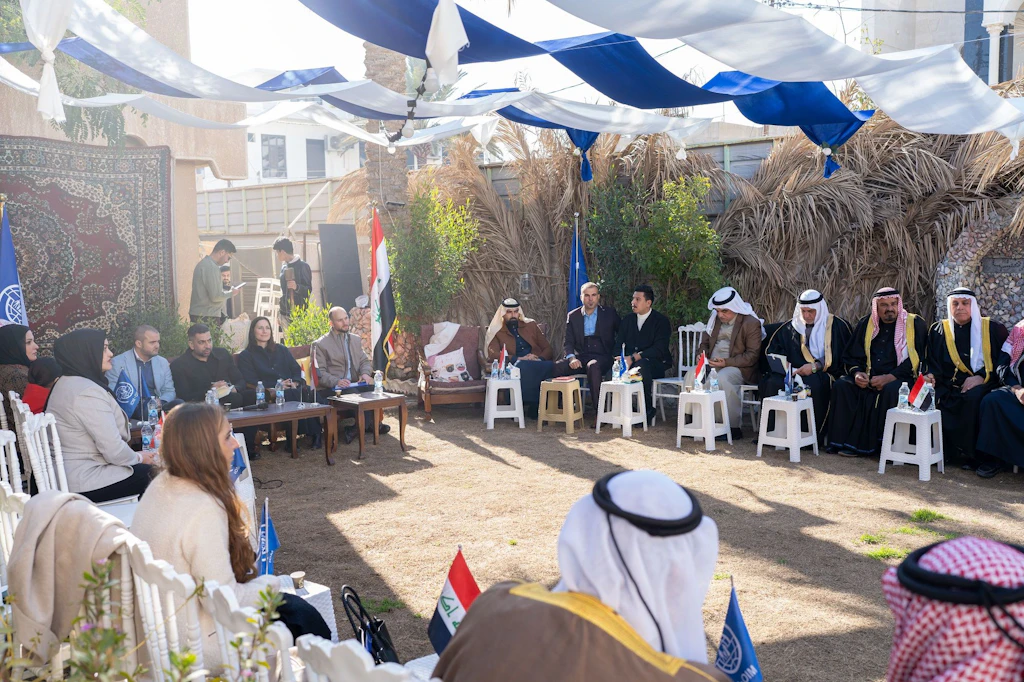
Through the Blue Peace Middle East initiative, Switzerland promotes regional water diplomacy in Iraq, facilitating dialogue and cooperation between Iraq and the neighbouring states with which it shares the Tigris-Euphrates basin. Switzerland supports joint water governance and strengthens local capacities, bringing together Iraqi institutions, experts and policymakers to develop shared solutions. The aim is to transform the challenge of water scarcity into an opportunity for cooperation, conflict prevention and sustainable development.
Partners: Blue Peace Middle East, Ministry of Water Resources, Ministry of Agriculture, University of Thi-Qar and Hashimgat Water Users Association.
Peace and good governance
Switzerland supports sustainable reintegration and durable solutions for displaced people and returnees and contributes to social cohesion in areas of return. Work in this area addresses the prevention of secondary displacement and strengthens community-level reconciliation alongside institutional capacity.
In close cooperation with the State Secretariat for Migration, Switzerland also supports migration governance, including institutional strengthening, return management and efforts to combat trafficking in human beings.
Key Swiss-supported activities include:
• Community-based reintegration and social cohesion in key areas of return.
• Support to government offices and training of officials responsible for civil documentation and migration management.
• Strengthened cooperation with the Iraqi authorities on return and reintegration.
Selected results 2019–2025:
• Switzerland supported the United Nations and the Iraqi Government in finding durable solutions to internal displacement through strategic Swiss secondments to the UN and project funding to IOM.
• 278 women and men were supported with improved labour market skills, and 274 benefited from improved income-generation opportunities.
Partners: International Organization for Migration, Ministry of Migration and Displacement, State Secretariat for Migration.
Outlook
Switzerland’s engagement in Iraq is focused but strategically relevant, concentrating on politically sensitive areas such as return, reintegration and civil documentation. Iraq is increasingly addressed within a regional migration framework linking developments in Syria, Iraq and Europe. Switzerland is exploring additional partnerships in support of livelihoods and local economic recovery, and on housing, land and property rights for displacement-affected households, in order to complement its protection and migration engagement with longer-term perspectives for durable solutions.